
Restaurant Training: How to Train Servers With No Classroom Time
"Why the classroom model doesn't work in a restaurant, and the three moments during a service shift that actually work for training."
A restaurant manager hires a new server on Monday and needs them ready for the weekend, when the restaurant is packed. There's no hour of the day when the whole team is available off the floor, no classroom, and the menu has three new dishes since the last time anyone ran formal training. The most common fix — "shadow him all night" — produces completely different results depending on who happened to be the shadow that night, and nobody has stopped to ask why the same job gets learned so differently from one person to the next, or whether that inconsistency is actually costing something.
This article applies the framework from 30-day onboarding for high-turnover operations to a restaurant's specific context, where the problem isn't just high turnover — as in retail turnover — but the near-total absence of off-service time to train formally.
Why the classroom model doesn't work in a restaurant
A classroom requires gathering people outside their normal tasks, at a shared time, with room to explain and practice without the pressure of real service. In a restaurant, almost none of those three conditions exist naturally: staff work staggered shifts, the business doesn't pause to train, and the menu or promotions change more often than any static document can keep up with.
There's a deeper reason too: much of what a new server needs to learn — the specific layout of the floor, how table flow moves, the point-of-sale system — is better learned in the real space, under real conditions, than in any classroom. The challenge isn't that the restaurant has nowhere to train — it's that the right "where" is the service floor itself, not a classroom, and pretending otherwise just delays training that could already be happening.
The model that actually works: learning during service, not before it
Instead of trying to create classroom time that doesn't exist, the alternative is structuring learning inside the service itself, without leaving it to chance. The difference between "shadow him all night" and structured shadowing isn't the time it takes — it's that the second has specific observation and practice tasks assigned for each shift, instead of relying on the more experienced person to improvise what to teach.
The three moments during a service shift that actually work for training
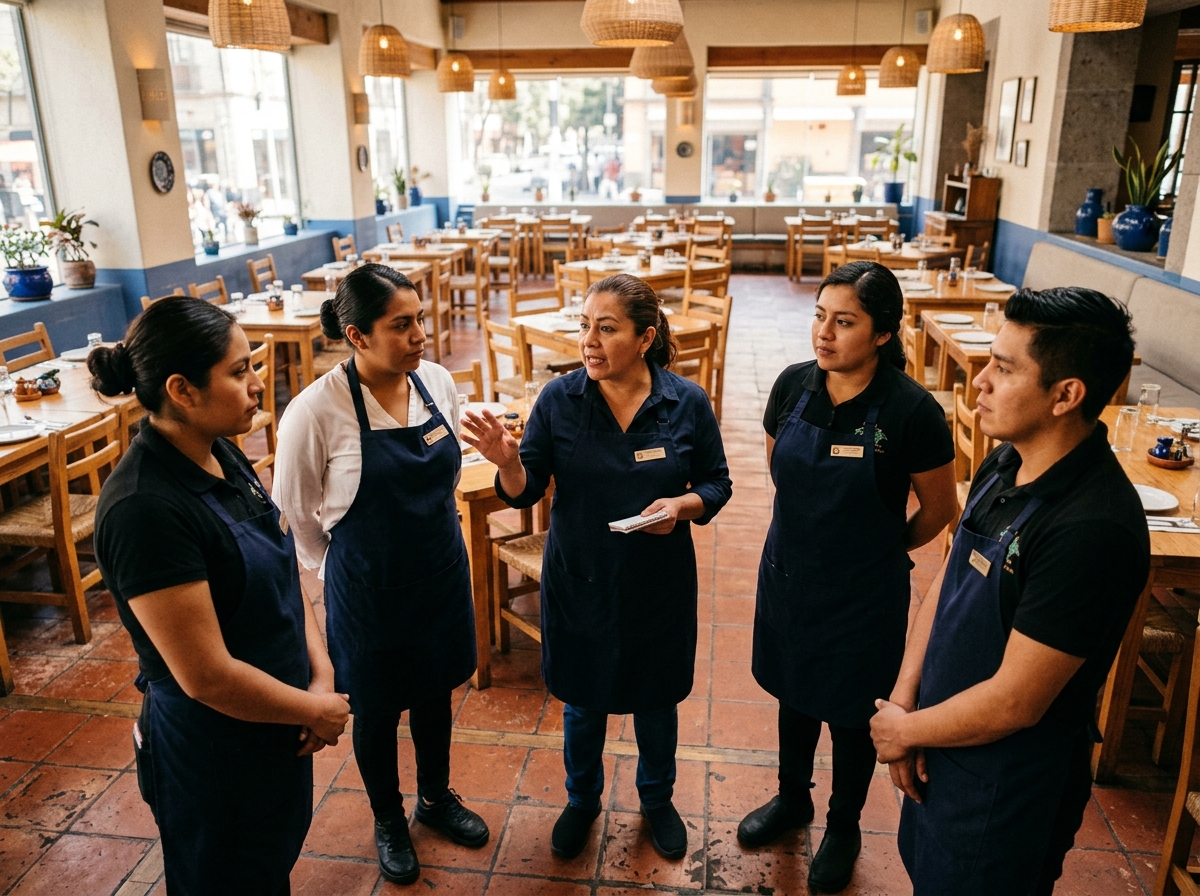
1. The pre-shift. The ten minutes before opening, which most restaurants already use to review the day's menu, are also the natural moment to give the new hire a brief, specific instruction: what they're expected to observe or practice that particular night, not a long list of everything they should eventually learn.
2. Active shadowing during low-demand hours. Not every hour of the night is the same — the slower hours are the lowest-risk moment for the new hire to practice specific tasks, instead of just observing. The article on customer service workshop already explains why real practice, not just observation, is what builds the skill needed under real pressure — in a restaurant, low-demand hours are where that practice can start with the least risk.
3. The post-shift debrief. Five minutes at closing, before everyone leaves, to review one or two concrete things that went well or need adjusting next time. It isn't a formal evaluation — it's the early feedback that, as the onboarding pillar explains, is one of the practices that most sustains learning in the first few weeks.
How to standardize shadowing so it doesn't depend on who's on shift
The biggest weakness of the "shadow him all night" model is that experience quality depends entirely on who's on shift that day. The fix is the same one explained in retail turnover for the checklist shared across supervisors: a simple checklist for whoever is mentoring, specifying what to show and what to let the new hire practice during each shadowing shift. This doesn't eliminate variation between mentors — everyone teaches differently — but it does guarantee everyone covers the same minimum points, regardless of which one ends up with the new hire.
What a shadowing checklist looks like in practice
For the first three shadowing nights, a simple checklist might look like this:
Night 1 (observation with one task): show the full floor layout and station locations, let the new hire take a drink order alone at a low-complexity table, with the mentor present but not stepping in unless needed.
Night 2 (guided practice): let the new hire take a full order at a table, with the mentor reviewing before it goes to the kitchen. Show how a simple complaint gets handled, even if they're not resolving it themselves yet.
Night 3 (practice with less supervision): the new hire handles a full table alone, from greeting to check, with the mentor available but at a distance, stepping in only if something goes off track.
Any mentor who gets this same checklist — regardless of their own teaching style — covers the same minimum ground over the same three nights, which is the whole point: consistency doesn't require everyone to teach identically, just to hit the same floor.
Menu knowledge: the challenge that never ends
Unlike other sectors where job knowledge is relatively stable, in a restaurant the menu, promotions, and daily specials change constantly. This turns knowledge updates into an ongoing process, not something solved once during initial onboarding. The daily pre-shift is the natural mechanism for this — communicating the day's changes to the whole team at once, instead of relying on each person to check a document on their own, which is exactly the kind of system that gets lost in daily operations if it isn't built into a routine that already exists.
Frequently Asked Questions
Why doesn't the classroom model work for training servers?
Because there are no off-hours to gather the whole team, the menu and promotions change often, and much of what needs to be learned — the floor layout, the point-of-sale system — is better learned in the real space than in any classroom.
What are the three moments during a service shift that work for training?
The brief pre-shift before opening, active shadowing during low-demand hours with specific assigned tasks, and a short debrief at closing. None of the three requires extra time outside the normal shift.
How do you keep training quality from depending on whoever ends up shadowing that night?
With a simple checklist for whoever is mentoring that night, specifying what to show and what to let the new hire practice during each shadowing shift, instead of leaving it entirely up to whichever experienced person happens to be on shift.
How do you keep menu knowledge current when it changes often?
With a lightweight recurring update system, not just initial training. The daily pre-shift is the natural mechanism for this — communicating the day's changes to the whole team at once, instead of relying on each server to check a document on their own.
In summary
A restaurant has no classroom time, but it does have three moments within every service shift that can be structured for training without stealing time from operations: the pre-shift, active shadowing during slow hours, and the closing debrief. A simple checklist for whoever mentors keeps experience quality from depending entirely on who's on shift that night, and the daily pre-shift solves the challenge of a menu that never stops changing.
To adapt the general onboarding map to this specific service rhythm, the 30-day onboarding map already has the base structure ready to adjust to the three moments in each shift.
And to certify task by task without depending on a specific mentor being on shift every night, at Hypsen that's exactly the validation we work on.
30-Day Onboarding Map for Restaurants & Floor Staff
Download the editable framework to structure server onboarding and shift follow-ups without stopping operations.
Verify if your servers master the menu and guest service before the weekend rush
Hypsen validates spoken menu knowledge, guest objection handling, and table readiness in minutes.