Hypsen vs traditional LMS

They aren't direct competitors. An LMS manages and distributes training; Hypsen proves whether it worked. Most companies that have an LMS keep it.

Hypsen vs traditional LMS

What is the difference between Hypsen and an LMS?

An LMS (Learning Management System) manages training: it hosts courses, enrolls people, tracks progress and issues certificates. Hypsen validates readiness: it defines the job profile, diagnoses each employee's actual level, generates training from the company's documents, and proves performance through voice interview and simulation of real situations. The LMS answers "who took the course?"; Hypsen answers "who can do the job?" They can run in parallel.

LOGISTICAL STRENGTHS

Let's start with what an LMS solves, and solves well

Its job is logistical, and it does it better than any alternative:

  • Hosts and organizes a course catalog in one place.
  • Enrolls and assigns training by role, department or campaign.
  • Tracks progress and completion, with reports on who started and who finished.
  • Documents compliance, with certificates and audit trails.
  • Integrates with payroll and HRIS, syncing hires, exits and org structure.

If your primary need is distributing content to a lot of people and being able to prove it was distributed, an LMS is the right tool and Hypsen doesn't replace it.

Employee practicing interactive AI voice training with Hypsen
Multiple choice exam vs real spoken performance Hypsen
MEASUREMENT LIMITS

The problem isn't what the LMS does. It's what it can't measure.

An LMS reports three things: enrollment (signed in), progress (video ran to completion) and exam score (recognized the right answer). None of the three predicts performance.

Producing an answer out loud in front of a real customer who interrupts requires a living capability that cannot be measured in a written test.

💬 THE REPORT GAP:

"In the LMS report, that person shows up as 100% trained — but in the real call with the customer, they go silent."

Comparative Table

What each one measures

Feature Traditional LMS Hypsen
Question it answers Who took the course? Who can do the job?
Unit of measure Completion and score Readiness 1 to 10 against what the role demands
Starting point A catalog of topics The job profile in your company
Content origin Own or third-party catalog; loaded manually Built from your documents, websites and videos
Content production Requires recording, editing and layout Syllabus, slides and visuals generated from the material
Personalization Same sequence for everyone Modules assigned by diagnosed gap
Interaction during class One-way video Real-time voice, response in under 1.5 seconds
Questions during operations Not covered Tutor available by voice or chat
Assessment Multiple choice, text Voice interview in STAR format and conversational simulation
Feedback A score What was missing, with detail
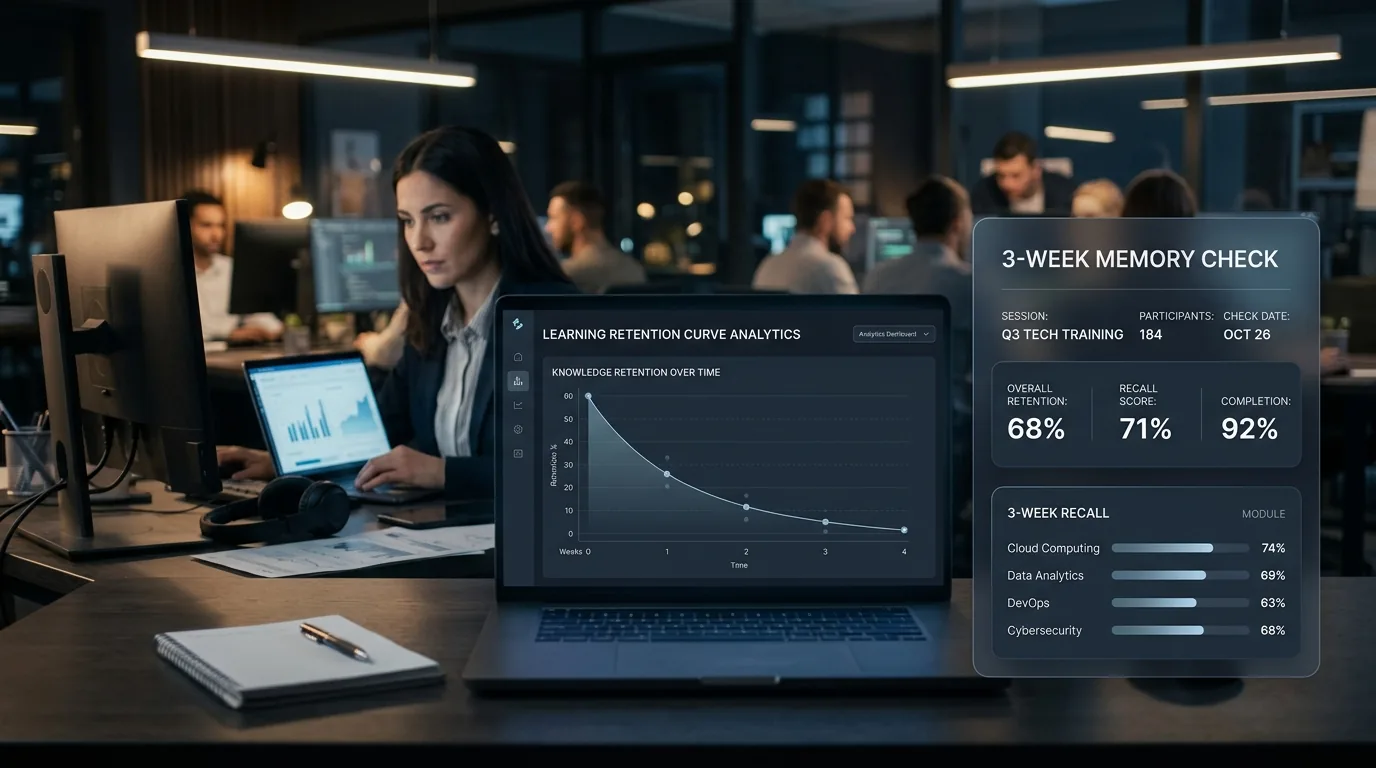
Retention measurement Not standard New assessment schedulable weeks later
Content updates Manual, course by course Reupload the document and modules rebuild
Mexican DC-3 certificates Yes, on Mexican platforms No
Payroll and HRIS integration Yes, it's their strength Limited
Prebuilt topic catalog Extensive Not applicable: built from the customer's material
Pricing model Per user, almost always Per usage capacity; unlimited users
LMS USE CASES

Three cases where you shouldn't trade your LMS for Hypsen

Hypsen does not seek to replace the specialized functionality that an LMS handles maturely.
Formal STPS compliance Hypsen
COMPLIANCE

1. Formal compliance

If your need is documenting training for a labor authority and issuing official certificates, Hypsen doesn't cover it. An LMS with a compliance module does.

Non-operational corporate catalog Hypsen
CORPORATE CATALOG

2. Non-operational catalog

Workplace climate, ethics, diversity, harassment prevention, generic regulatory subjects. A prebuilt third-party catalog is faster and cheaper there than building from your documents.

Deep HR ecosystem integration Hypsen
HR ECOSYSTEM

3. Deep HR integration

Automated sync with payroll, enterprise performance reviews, compensation and succession planning.

STRATEGIC COEXISTENCE

The LMS distributes. Hypsen proves.

The most common setup in companies that already have an LMS installed:

The LMS keeps the corporate catalog, regulatory compliance, certificates and HR integration.

Hypsen is added in the roles where performance is measurable and expensive when it fails: sales force, customer-facing staff, floor operations, high-turnover positions.

The typical flow: the employee takes the theoretical part where they already take it, and before being released to work unsupervised, they go through Hypsen's validation. The readiness report is what authorizes release, not the attendance certificate.

🚀 NO-FRICTION COEXISTENCE:

Nobody has to migrate anything. Both tools collaborate in parallel respecting their strengths.

Operational validation and release Hypsen
DECISION GUIDE

Three questions

Three strategic criteria to determine when to use your LMS or add Hypsen's validation.

Distribution vs validation Hypsen
DISTRIBUTION VS VALIDATION

Is your problem distributing or proving?

If your people aren't receiving training, you need an LMS. If they are receiving it and still arrive unprepared, you need validation.

Conversational performance Hypsen
CONVERSATIONAL PERFORMANCE

Does the role involve conversational performance?

Selling, handling a complaint, explaining a procedure, managing an objection. If so, a written exam doesn't measure it and a simulation does.

Unprepared cost Hypsen
UNPREPARED COST

What does it cost when someone isn't ready?

If the cost of an unprepared person is a lost sale, a customer who cancels or a safety incident, validation pays for itself. If the cost is low, completion is enough.

Frequently Asked Questions

Hypsen vs LMS FAQs

Is Hypsen an LMS?
No. An LMS manages and distributes training; Hypsen validates readiness through interview and simulation. They cover different needs and can coexist.
Do I have to drop my LMS to use Hypsen?
No. Most customers keep their LMS for catalog and compliance, and add Hypsen in the roles where performance matters.
Does Hypsen issue Mexican DC-3 certificates?
No. It delivers performance evidence and internal reference certificates.
Can I use Hypsen without an LMS?
Yes. Many mid-sized companies in Mexico have no LMS and train with in-person instructors and loose materials. In that case Hypsen covers both delivery and validation.
Do they integrate with each other?
Tailored integrations are covered in the Custom plan. In practice, most companies run both tools in parallel without integrating them.
What happens to the content I already have in my LMS?
It stays where it is. Hypsen builds its programs from source documents — manuals, policies, procedures — not from already-authored courses.