Measure, train the gap,
measure again
Training is one stage of the process, not the product. The product is knowing whether the person can do the job — in your company, with your rules.

The Complete Hypsen Job Readiness Cycle
Hypsen operates as a seven-stage cycle: the job profile is defined, each person is assessed through a voice interview, a skills map with their gaps is generated, training is built from the company's documents focused on those gaps, it's delivered in a classroom with a virtual tutor, performance is assessed through exam, voice interview or real-situation simulation, and the results feed a dashboard from which the next cycle starts.
Each stage depends on the one before it
On most platforms the features are independent: there's a course module, an assessment module, a reporting module. They can be used separately and nothing connects to anything.
In Hypsen the order matters: each stage builds on the previous one to deliver a real guarantee of job performance.
"That chain is what makes it possible to answer the question no course platform answers: can this person do this job?"
From role definition to performance verification
The order matters: each step builds on the results of the previous one.
Job profile
Defines what the role demands in your company.
Tasks, policies and the critical situations the person has to be able to resolve. It's the standard everything else hangs from, and it's organized around your real structure: units, departments and reporting lines.
See job profiles →Diagnostic
An interview, not a questionnaire.
By voice or text. It explores prior experience, knowledge of procedures, what they'd do in a specific situation, and whether they can explain in their own words what they claim to know.
See the diagnostic →Skills map
A 1-to-10 polygon by competency.
Not a percentage of progress: the person's actual level in each thing their role demands, compared against the 10 that represents expected performance for the role.
See the skills map →Tailored training
Generated from your material, focused on what's missing.
Documents, websites and videos become a complete course. Topics where the diagnostic shows mastery are pre-approved.
See course generation →Classroom and tutor
A tutor that explains rather than reads the slide.
A voice-led class you can interrupt to ask questions, with a response in under a second and a half. The tutor stays available outside the classroom to answer questions.
See classroom and tutor →Assessment
Three ways to prove it.
A quiz at the close of each topic, and at the end: written exam, AI voice interview, or a simulation of a real work situation.
See assessment and role-play →Dashboard
Who is ready and who needs reinforcement.
Scored 1 to 10 against what the role demands, by person, department and unit. Plus the gaps that repeat across the team, which are the ones worth group training.
See the readiness dashboard →The cycle doesn't end with the course
Weeks after a program closes you can schedule a new voice assessment. Comparing it against the first one shows what was genuinely retained and what cooled off.
That result feeds the dashboard and defines the next cycle: what to reinforce, in whom, and in which specific competency.
"And when a manual, a policy or a procedure changes, you upload the new version and the system rebuilds the affected modules — including in courses already published — flagging whoever needs to retake what changed."
No computer required
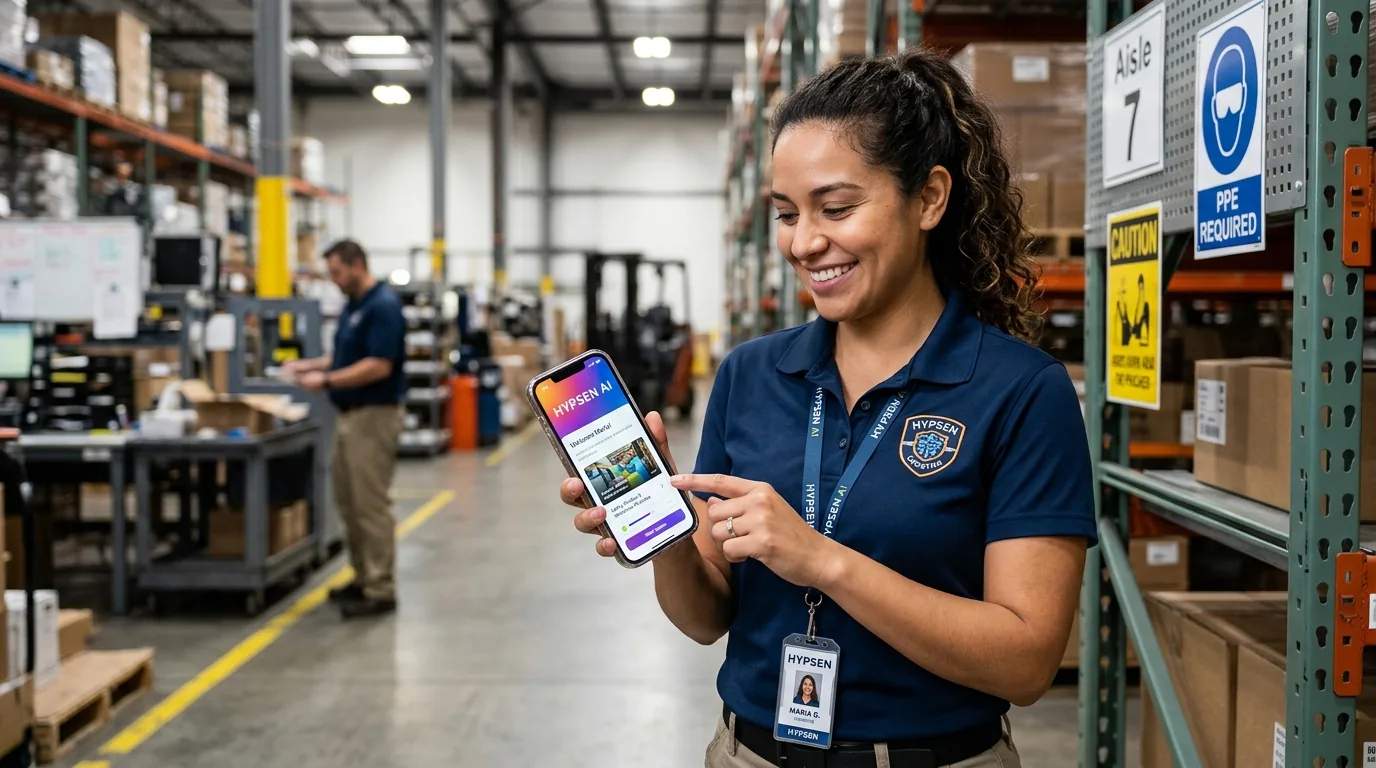
Hypsen has a native mobile app in addition to the web version. For field, floor or plant operations, that removes the friction of requiring someone to come to an office to train.