
Customer Service Workshop: What It Should Include to Change Anything on the Floor
Almost anyone can be pleasant when everything is going smoothly. What separates good customer service from bad is what happens when something goes wrong. A generic attitude workshop never prepares anyone for the four critical moments where customer experience actually gets decided.
A store trains its whole floor team in an "exceptional customer service" workshop: how to smile, how to greet, how to show genuine interest. Everyone leaves motivated. A month later, a customer returns a product with no receipt, and the same employee who smiled through the entire workshop gets tense, argues, and ends up escalating something that could've been resolved in thirty seconds. The workshop didn't fail because it taught attitude poorly — it failed because attitude was never the problem. The problem was that nobody had taught, or practiced with them, what to do specifically in that moment, and no amount of enthusiasm on workshop day was going to substitute for that.
This gets especially costly in operations with high floor-staff turnover, where every new hire goes through the same generic workshop without anyone noticing the content never addresses the moments that actually matter, and the cycle repeats with each new hire, quarter after quarter, without anyone connecting the dots.
Why a generic customer service workshop doesn't change anything on the floor
"Customer service" as a topic is as broad as "leadership" — it covers attitude, communication, problem-solving, and emotional management, all at once. A workshop that tries to cover the whole topic in general teaches principles that sound good but don't prepare anyone for the specific moment where the customer experience actually gets decided. Almost anyone can be pleasant when everything's going well. What separates good service from bad is what happens when something goes wrong.
The four moments that actually define the customer experience
1. Handling a complaint without letting it escalate. Hearing a complaint isn't the same as knowing how to respond to it without getting defensive or promising something that can't be delivered. An effective workshop teaches a concrete structure —acknowledge the problem, don't immediately justify it, offer a specific solution— and practices it until it becomes natural under pressure.
2. Recovering from your own mistake in front of the customer. When the mistake is the employee's own —overcharged, gave wrong information— the natural instinct is to get defensive or minimize it. A good workshop trains the opposite sequence: acknowledge the mistake directly, fix it fast, and don't turn the apology into a long excuse that drags out the discomfort.
Example: the same mistake, two ways to handle it
❌ Without specific training:
"Oh, sorry, it's just that the system sometimes glitches and that's why it sometimes overcharges, it's not that I made a mistake, actually this happened to me before with another customer..." The customer ends up hearing a long explanation about the system, without feeling like the mistake was really acknowledged or resolved quickly.
✅ With the trained sequence:
"You're right, I overcharged you. Let me fix that right now." No excuses, no minimizing, no dragging out the uncomfortable moment longer than necessary. The customer leaves feeling like the mistake was handled well, not like they had to convince someone a mistake even happened.
The difference isn't personality — it's having a clear structure to follow in the moment, instead of improvising through the discomfort of having made a mistake in front of someone.
3. Saying no to a request without it feeling like a door slamming. There are requests that legitimately can't be granted — a return outside policy, an unauthorized discount. The difference between a customer who leaves frustrated and one who leaves understanding the situation almost always comes down to how the "no" is delivered, not the fact of delivering it.
4. Recognizing when to escalate to a supervisor. Counterintuitively, part of good service is knowing when not to try to solve everything yourself. An employee who insists on resolving a situation that's already beyond their scope usually makes it worse. Teaching the signal for when to ask for help matters as much as teaching how to resolve things.

It's worth noting these four moments aren't exclusive to retail or restaurants — they repeat in any customer-facing role, including ones that aren't face-to-face. What changes between a store counter and a call center is the channel, not the nature of the moment: it's still a complaint, a mistake, a necessary "no," or the decision to escalate.
Why role-play matters more here than in almost any other workshop
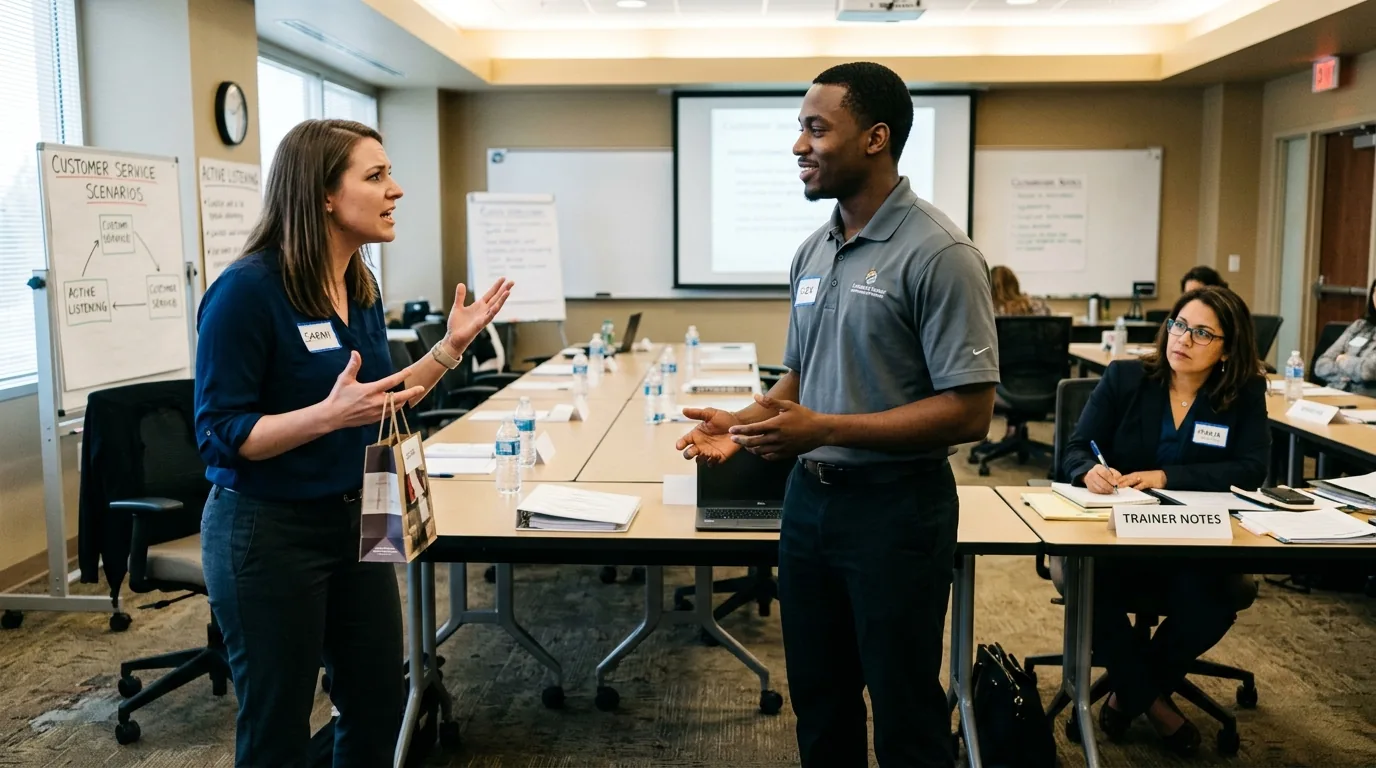
Customer service happens in real time, in front of someone who might be frustrated, with no time to think through a calm response. Knowing in theory what to say in a complaint isn't the same as being able to say it in a calm tone once the customer is already upset — that ability gets built by practicing the situation under some simulated pressure, not by memorizing a list of best practices. A workshop that spends most of its time on theory, with little real role-play, leaves people knowing what they should do without having practiced how to do it when it counts.
How to measure whether the workshop changed anything on the floor
A workshop satisfaction survey measures whether people enjoyed it, not whether they'll handle a real complaint better. To measure something real, you need direct observation — or mystery-shopper-style checks — focused specifically on the four moments that were trained, not a general impression of service quality. None of this requires new software; a supervisor with a short checklist and a few minutes after each shift is enough to start.
This connects to how to build a performance evidence system for your team: instead of asking "did service improve?", the right question is "does this person handle a complaint following the structure taught, yes or no?" — something that can be observed directly in the next real interaction, not something inferred from a general rating.
A practical way to start, without needing a formal system: pick one of the four moments as the priority for the quarter, and ask floor supervisors to log, even simply, every time they observe someone handling it well or poorly. Within a few weeks that log already says more about whether the workshop worked than any satisfaction score taken on event day.
Frequently Asked Questions
Why doesn't a generic customer service workshop change anything on the floor?
Because it teaches general attitude — smiling, being friendly, listening — without preparing the person for the specific moments where the customer experience actually gets decided: a complaint, their own mistake, a "no" that has to be delivered, or knowing when to escalate to a supervisor.
What are the moments that most define a customer's experience?
Four: handling a complaint without letting it escalate, recovering from your own mistake in front of the customer, saying no to a request without it feeling like a door slamming, and recognizing when to escalate to a supervisor instead of trying to solve everything alone.
Why does role-play matter more in this workshop than in others?
Because customer service happens in real time, under emotional pressure, in front of someone who's frustrated. Knowing in theory what to say isn't the same as being able to say it calmly once the customer is already upset — that ability only gets built by practicing the situation, not by explaining it.
How do you measure whether a customer service workshop changed anything on the floor?
Through direct observation or mystery-shopper-style checks focused on the specific moments that were trained, not a workshop satisfaction survey. The right question is whether the person handles those moments differently than before, not whether they enjoyed the workshop.
In summary
A customer service workshop that teaches general attitude leaves people knowing they should "be friendly," without preparing them for the four moments where the customer experience actually plays out: a complaint, a mistake of their own, a necessary "no," or knowing when to ask for help. Practicing those four moments with real role-play, and measuring afterward with direct observation instead of satisfaction surveys, is what separates a workshop that changes something from one that just felt good on the day it happened.
The same price factors for any corporate workshop are explained in how much does a sales workshop cost for a company in Mexico. And to confirm whether those four moments really get handled differently on the floor, at Hypsen that's exactly the validation we work on with interactive voice assessments.
Want to know if your customer-facing employees are truly ready for the floor?
Hypsen validates via voice whether an employee is ready for their role, using your company's actual manuals and procedures. It delivers objective performance evidence, person by person.